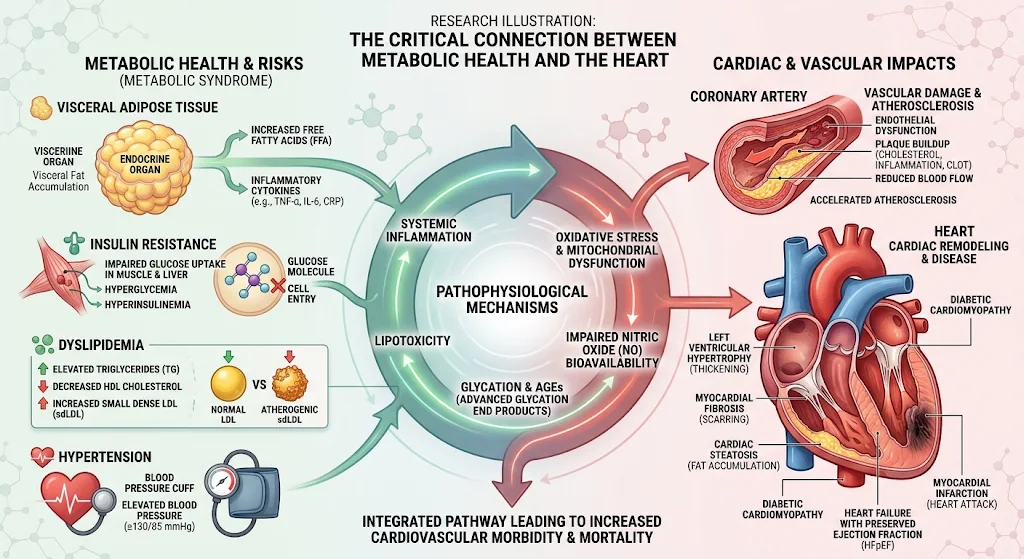
Survodutide Meets a Heart-Safety Goal, but Benefit Claims Need Care
Investigational obesity medicine survodutide has met the prespecified cardiovascular safety goal in SYNCHRONIZE-CVOT, a large phase 3 study published in The Lancet (The Lancet). The result provides evidence about heart-related safety, but it does not establish that the medicine prevents heart attacks or strokes.
That distinction is central to interpreting the November update. The trial was designed to test non-inferiority to placebo within a specified margin, rather than to assume that improvements in weight or metabolic measurements would translate into fewer cardiovascular events (The Lancet).
What researchers measured
The study randomized 5,530 adults with overweight or obesity and elevated cardiovascular risk, including participants with established cardiovascular disease or qualifying chronic kidney disease (The Lancet). Participants received weekly survodutide or placebo, and median time in the study was 22 months (The Lancet).
Its primary endpoint combined cardiovascular death, nonfatal stroke, nonfatal heart attack, ischemia-related coronary revascularization, and heart-failure events (The Lancet). That endpoint occurred in 3.7% of participants receiving pooled survodutide treatment and 4.1% receiving placebo, with a hazard ratio of 0.89 and a 95% confidence interval of 0.67 to 1.18 (The Lancet).
The confidence interval includes 1.0, so the result should not be presented as proof of a cardiovascular event reduction. Meeting a safety criterion is a meaningful step, but it answers a narrower question than demonstrating superiority.
Metabolic findings do not replace outcome evidence
Boehringer Ingelheim also reported improvements in blood pressure, waist circumference, and body weight at week 72 using a supplementary analysis estimating effects with continued treatment (Boehringer Ingelheim). Pharmacy Times emphasized that the cardiovascular findings support safety rather than established cardiovascular benefit (Pharmacy Times).
Those different outcomes should remain separate in coverage. A favorable change in a risk marker is not automatically a measured reduction in heart attacks or strokes.
Tolerability remains a substantial consideration
Gastrointestinal adverse effects caused treatment discontinuation in 19.3% and 20.8% of participants in the two survodutide dose groups, compared with 1.9% on placebo (The Lancet). Nausea and vomiting were more frequent with survodutide, although serious adverse-event rates were similar across groups (The Lancet).
The sponsor’s announcement describes survodutide as investigational and not approved for use (Boehringer Ingelheim). The current story is therefore a research milestone that includes both reassuring cardiovascular findings and a significant tolerability challenge, not an announcement of a newly available treatment.
FAQ
Did survodutide prove that it prevents heart attacks?
The trial met its cardiovascular non-inferiority endpoint, but its primary result did not establish superiority over placebo (The Lancet). It should not be described as proof that survodutide reduces heart attacks or strokes.
What was the main tolerability issue?
Gastrointestinal effects led around one in five participants in each survodutide group to stop treatment, compared with 1.9% on placebo (The Lancet). This finding is an important counterbalance to the favorable safety-endpoint and metabolic results.